
Iris ensata (Japanese Iris)
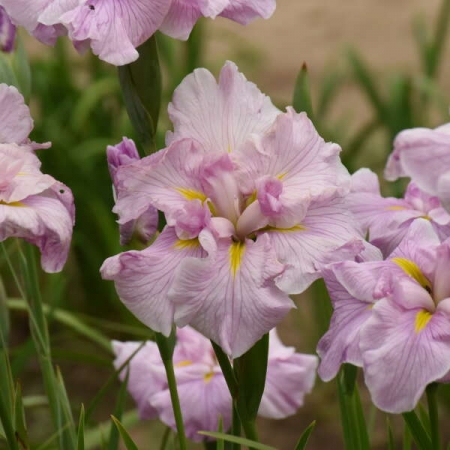
Color Name: Pinkerton
A beautiful Japanese Iris with soft pink flowers. Pink crests arch above six bands of showy falls with dark veining and rippled edges. Bloom size on 'Pinkerton' is consistent with other Japanese Iris at 7" wide, nearly twice the size of some Siberian Iris. These plants are later to bloom, sometimes not flowering until a month after Siberian Iris have started.
Unlike the Tall Bearded Iris, the beardless Japanese Iris has a flat bloom, narrower leaves, and smaller, more compact rhizomes. They have the largest flowers of all irises, and make wonderful spring accents for the edge of water gardens. Japanese irises are the latest to bloom, about a month after the Siberian irises.
Growing Tips: Location: Choose a spot with full sun (at least six hours per day) for the best blooms. Afternoon shade is beneficial in very hot climates.
Soil: These plants prefer rich, acidic soil with a pH of 5.0-6.5.
Mix in plenty of organic matter, such as compost or well-aged manure, to improve fertility and moisture retention. Do not add lime or wood ash, as this is harmful to Japanese irises.
Depth: Plant the rhizomes deeper than other iris varieties, about 2 to 3 inches deep, to account for their upward growth habit.
Spacing: Space individual rhizomes 18 to 24 inches apart to give them room to grow.
Initial care: After planting, soak the roots overnight before planting, and water thoroughly to settle the soil.
Photo courtesy of Walters Garden, Inc.
|
Flower Color: Pink Shades Foliage Color: Green Shades
Height: 36 to 38 Inches Spread: 24 to 28 Inches Hardy in Zone: 4, 5, 6 |
Blooms: Late Spring / Early Summer
Foliage Season: All Season |
Exposure

Full Sun

Partial Shade
Soil Moisture Needs

Moist
Attributes |
Border Cut Flower or Foilage Easy to Grow Landscapes Mass Planting Specimen Plant
|
Attracts

Butterflies
Hummingbirds
Critter Resistance

Deer

Rabbit